

Revolutionary Objective Assessment for Emergency Departments
The Scarlet Scale transforms victim identification for healthcare professionals. Our groundbreaking assessment eliminates direct questioning, offering a competent, reliable solution for recognizing individuals trapped in commercial sexual exploitation.
How Does the Tool Work?
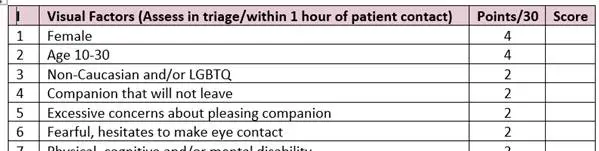
A snippet of the tool:
Section I of the Scarlet Scale uses 31 indicators identified during the nurse's initial physical assessment. Most are objective, while others require a simple chart or lab review. A significant score of 30 should prompt a Social Worker consultation to determine if the patient requires immediate help or resources.
Section II of the Scarlet Scale uses 9 indicators that require more time with the patient beyond the initial assessment. To uncover these indicators, nurses must develop exceptional listening skills to build a relationship based on trust and respect. A significant score of 10 in this section should also trigger a Social Worker consultation.
It is not necessary to score both sections to suspect human sex trafficking. Since every victim's story is unique, scores will vary, making the whole clinical picture more important than individual indicators. The ultimate goal is simply to identify when exploitation exists and ensure victims are aware that resources are available.


Development and Methodology
Forty indicators were identified and formatted with a scoring system. These indicators are designed to be used objectively, without any direct questioning, as victims are unlikely to be forthcoming about their circumstances. The tool has undergone two pilot projects in large urban Midwest city emergency departments, resulting in changes to the format and scoring for ease of use.
The Solution
Combating human sex trafficking requires a dedicated, multi-faceted approach within the healthcare environment, focusing on two key pillars:
1. Healthcare Worker Education
We must start with a foundation of adequately informing medical professionals about the critical warning signs ("red flags") and the inherent vulnerabilities associated with human sex trafficking.
2. Developing Hospital Task Forces
Every hospital should consider establishing a multidisciplinary anti-trafficking task force with the following operational objectives:
- Resource Management: Compile a comprehensive database of local and national support and assistance resources.
- Performance Review: Review successful identification efforts and close-call intervention scenarios.
- Strategic Partnerships: Collaborate with neighboring healthcare facilities and victim advocacy organizations.
- Policy Development: Create clear operational policies and protocols specifically concerning human trafficking victims.
- Safe Exit Planning: Ensure a defined and safe departure strategy is readily available for victims.
- Staff Training:
- Instruct emergency department personnel on how to properly administer the Scarlet Scale tool.
- Educate emergency department staff to apply trauma-informed care practices to every patient interaction.
- Provide training to emergency department personnel on effective methods for patient charting and record-keeping.
You Can Make a Difference
We equip healthcare professionals to recognize and assist trafficking victims without invasive questioning, ensuring safety and dignity.